Program Will Welcome First Cohort of Residents to Train in Enhanced Facility
To help prepare and train future physicians, ThedaCare is announcing the completion of its new Simulation Lab, a cutting-edge training environment designed to support its Graduate Medical Education (GME) program and enhance clinical education. The new space reflects ThedaCare’s ongoing commitment to advancing workforce readiness and delivering high-quality care throughout the region.
ThedaCare is one of the first health systems in northeast and central Wisconsin to offer an accredited GME program. The program was created to help address physician shortages across Wisconsin, particularly in rural and underserved areas. The ThedaCare Internal Medicine Residency program received accreditation in September 2025, and will welcome the first residents on July 1, 2026.
“The completion of our Simulation Lab represents another significant investment in the future of health care in our communities through our Graduate Medical Education Program,” said Chris Stenberg, MD, vice president of graduate medical education and clinical research for ThedaCare. “By creating a shared, immersive learning environment, we are equipping our residents and teams with the skills, confidence and collaboration needed to deliver exceptional care to every patient, every time.”
The 2,200 sq. ft. Simulation Lab features three fully equipped simulation rooms outfitted with advanced technology, a dedicated debrief room and a centralized control center. Each simulation room is designed to replicate real-world inpatient clinical environments, incorporating the same tools and systems used across ThedaCare facilities. The flexible design also allows the space to be adapted to simulate a wide range of care settings.
The first use of the Simulation Lab took place earlier this month when it was used to support the onboarding and training of approximately 70 nurse externs. Over time, the space will serve a broad range of learners, including physicians in training, nurses and interprofessional care teams, creating a shared environment that promotes collaboration and continuous learning.
“A dedicated simulation space plays a critical role in preparing health care professionals for the complexities of modern care delivery,” said Dr. Stenberg. “Through realistic, hands-on training, residents and team members can practice high-risk, low-frequency clinical scenarios, strengthen clinical judgment and refine coordinated responses to critical situations – all within a safe and controlled environment.”
Dr. Stenberg explained the intentional integration of graduate medical education with interdisciplinary team training makes this space unique. By bringing together learners from across clinical roles, the Simulation Lab fosters a collaborative approach to care, better preparing both current and future health care professionals to work as cohesive teams in real-world settings.
Advancing Resident Training
The Simulation Lab is part of ThedaCare’s broader strategy to expand its GME program and strengthen the pipeline of highly trained health care professionals serving northeast and central Wisconsin.
Data from the Wisconsin Hospital Association shows Wisconsin needs between 2,000 and 4,000 additional physicians by 2035. Studies show nearly 55% of individuals who complete residency training remain in the community in which they train to practice medicine. Further, 70% of physicians stay in the state when they complete both their GME and residency in the same state.
Froedtert ThedaCare is working in concert with the Medical College of Wisconsin Affiliated Hospitals for the GME program to advance knowledge and train future medical professionals. The effort strategically supports the health system’s mission of advancing the health of the communities through excellence and discovery.
Foundations Support
ThedaCare Family of Foundations played a critical role in advancing the investment of the GME program by supporting construction and development efforts. By mobilizing more than $4 million in philanthropic resources through the ThedaCare Foundation-Neenah, the initiative helps ensure residents, team members and the broader community benefit from a modern training center equipped with the latest technology and thoughtfully designed learning spaces.
“We are overwhelmed with gratitude and excitement as we witness the incredible enthusiasm our community has shown for this program,” said Barbara Beuscher, senior vice president and chief philanthropy officer. “There is a special affection here – this initiative truly resonates with our community because we share a deep belief in the power and importance of strong health care. The steady support of our donors shows how much they care about building a healthier community for all.”
In addition to the Simulation Lab, in 2025, Froedtert ThedaCare announced the development of townhouses for future medical residents. The on-campus housing for residents and fellows can allow residents to focus more on training, while caring for patients and families. The property is adjacent to ThedaCare Regional Medical Center-Neenah at the corner of First Street and East Forest Avenue on Doty Island in Neenah. Construction of approximately 56 townhouses is underway.
The first phase of the project consists of two buildings and 28 units on the west half of the property. Construction began in October 2025 and is expected to be complete in summer 2026. The second phase is composed of two buildings and 28 units on the east half of the property, with construction set to begin in fall 2026. Plans call for 32 one-bedroom and 24 two-bedroom townhouses. Each unit would have an attached one- or two-car garage.
For more information about ThedaCare’s Graduate Medical Education Program, visit ThedaCare.org/about-us/medical-education/graduate-medical-education/.
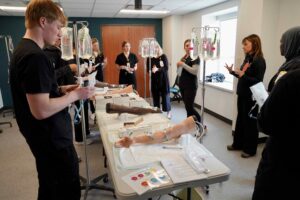
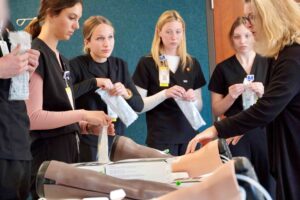
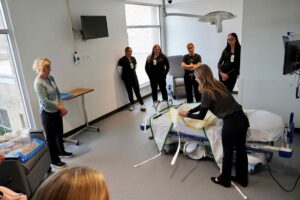
[To help prepare and train future physicians, ThedaCare has completed its new Simulation Lab, a cutting-edge training environment designed to support its Graduate Medical Education (GME) program and enhance clinical education. The 2,200 sq. ft. Simulation Lab features three fully equipped simulation rooms outfitted with advanced technology, a dedicated debrief room and a centralized control center. Each simulation room is designed to replicate real-world inpatient clinical environments, incorporating the same tools and systems used across ThedaCare facilities. The flexible design also allows the space to be adapted to simulate a wide range of care settings. The first use of the Simulation Lab took place earlier this month when it was used to support the onboarding and training of approximately 70 nurse externs. Over time, the space will serve a broad range of learners, including physicians in training, nurses and interprofessional care teams, creating a shared environment that promotes collaboration and continuous learning.]
About ThedaCare
For more than 115 years, ThedaCare® has been improving the health and well-being of the communities it serves in northeast and central Wisconsin. The organization delivers care to more than 650,000 residents in 17 counties, and employs approximately 7,000 providers and team members at 180 points of care, including 10 hospitals. As an organization committed to being a leader in Population Health, team members are dedicated to empowering people to live their unique, best lives. ThedaCare is a not-for-profit health system with a level II trauma center, comprehensive cancer treatment, stroke and cardiac programs, as well as primary care. ThedaCare also partners with communities to understand needs, find solutions together, and encourage health awareness and action. ThedaCare is part of Froedtert ThedaCare, Wisconsin’s most comprehensive health care system.
About Froedtert ThedaCare
Froedtert ThedaCare is an integrated health care system serving nearly half of Wisconsin’s population. Its 28,000+ team members, physicians and clinicians are transforming communities through prediction, prevention and partnerships with excellence in primary and specialty care in 20 hospitals and more than 360 outpatient locations. Together with the Medical College of Wisconsin, we form the region’s only academic medical center, providing the foundation for groundbreaking medical research and excellence in education to accelerate discovery and drive innovation. The system is uniquely positioned to be the trusted partner in advancing the health of our communities.
For more information, visit thedacare.org or follow ThedaCare on social media. Members of the media should call Cassandra Wallace, Director of Strategic Communications, at 920.442.0328.