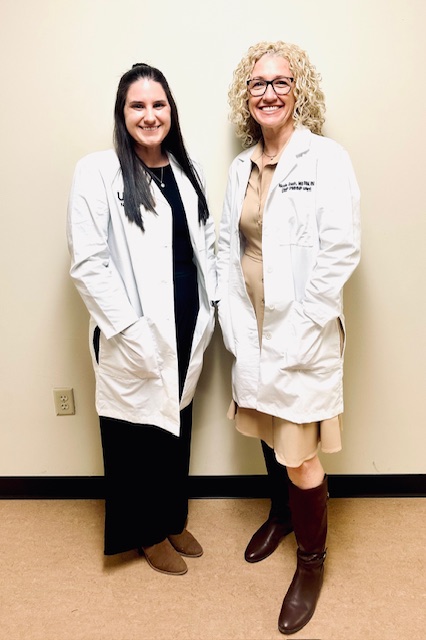
For many across the health professions, the White Coat Ceremony marks a profound transition – the moment when years of study give way to hands‑on clinical practice. Originally rooted in medical education, these ceremonies have increasingly become a meaningful rite of passage in nursing programs.
Since 2014, when the American Association of Colleges of Nursing partnered with The Arnold P. Gold Foundation to introduce white coat ceremonies nationwide, thousands of nursing students have participated in this ritual emphasizing humanistic, patient‑centered care.
At the University of Wisconsin-Oshkosh, this ceremony – often called an oath ceremony in nursing -symbolizes a commitment to compassion, integrity, and professionalism. Students recite an oath, receive a commitment pin, and reflect on the responsibilities they carry as emerging providers.
For Kelsey Laabs, MSN, RN, SSM Health Ripon Community Hospital Emergency Room/Administrative Supervisor/Day Surgery, and Nicole Dash, DNP, SSM Health Ripon Community Hospital Administrative Supervisor/Psychiatric Mental Health Nurse Practitioner, the ceremony represented both a professional milestone and a deeply personal moment.
Nicole Dash: A Journey Rooted in Service and a Growing Need
Nicole’s path to advanced practice nursing was unconventional. Before entering health care, she built a career in education and the legal field. But she felt called toward something more universal – something deeply human.
“I came to health care after a career in education and the legal field,” Nicole explains. “I was drawn to health care because I came to see this area of life as a universal human experience. It is a field where anyone can have a positive influence on another person in need, and at some point in our lives we all face health care concerns.”
As a floor nurse, Nicole began to see a pattern that would shape her future. “After a few years as a floor nurse, I noticed the prevalence of mental health needs across all demographics and the lack of available care. I became interested in ways mental health care could be expanded in our community,” she says. “This motivated me to become a psychiatric nurse practitioner.”
Throughout her nursing education, Nicole remained deeply connected to SSM Health Ripon Community Hospital. She served in multiple roles, including ER registration receptionist, CNA, PRN RN, and later as a nurse on 5 South at SSM Health St. Agnes Hospital – eventually becoming a charge nurse and Evidence-Based Practice (EBP) Fellow. Today, she serves as a House Supervisor while maintaining a PRN position on 5 South.
Kelsey Laabs: Inspired at 13 – Called to Nursing Ever Since
Kelsey’s path to nursing began long before she donned her white coat. “I pursued nursing following a surgery I had when I was 13 years old,” she shares. “I was so scared but had an angel of a nurse that kept me calm and comfortable and made sure I laughed throughout the process.”
Just before heading into surgery, that nurse said a phrase Kelsey never forgot: “Time to put your party hat on!”
“That was the moment I knew I wanted to be like her,” Kelsey says.
Her journey accelerated from there. She earned her CNA at 16, then advanced through roles across emergency care, neuro/med‑surg, and eventually teaching. Today, she balances her work at Ripon with a full‑time faculty role in the UW‑Oshkosh School of Nursing and Health Professions. She also continues her own studies, pursuing a Doctor of Nursing Practice-Family Nurse Practitioner degree.
A Ceremony Marking the Transition to Advanced Practice
Both Nicole and Kelsey describe the White Coat Ceremony as a pivotal moment – one that signifies the shift from theoretical learning to advanced clinical responsibilities.
For Nicole, the experience was profoundly meaningful. “It was wonderful to see so many people working toward higher levels of nursing care,” she says. “I enjoyed seeing people I knew as an undergrad or from previous jobs and hospital systems all come together to celebrate nursing and each other.”
Having her family present made the moment even more special. “Having my kids there was a wonderful way to expose them to the possibility of careers in health care,” she adds.
Kelsey also felt the emotional significance of the milestone. “The cloaking of the white coat represents the transition to advanced clinical practice, compassion, professionalism, and integrity,” she says. “This was an experience I will honor as I stood among my student colleagues and those from other specialties.”
Preparing for the Next Chapter
For both nurses, the ceremony marks the beginning of the clinical phase of their APRN preparation – where they will complete rotations, gain hands‑on experience with preceptors, and further develop advanced clinical judgment.
“We’re ready to get hands-on experience and required patient encounters before graduation and boards,” according to Kelsey. Providing advanced care to patients of all ages has helped me understand medicine in a deeper way.”
Nicole echoes this enthusiasm, offering encouragement to others considering the journey. “Stay diligent and curious – there is much to learn,” she says. “The field of mental health grows more critical every day. The skills you acquire are universal and can deeply impact people’s lives.”
Looking Ahead
Kelsey and Nicole both credit their success to strong support systems – family, colleagues, managers, and mentors. And both are driven by the belief that advanced practice nursing allows them to widen their impact on the individuals and communities they serve.
Kelsey’s advice: “For anyone thinking about going back to school, I would say do not hold back! It is hard, but it has been rewarding.”
Nicole’s message: “The journey is worth it. The impact you can make is profound.”
Together, their stories highlight not only the meaning of the White Coat Ceremony – but the dedication, compassion, and purpose that define what it means to advance in the nursing profession.