Annual Event Helps Fund Local Cancer Programs, Services and Research
Lisa Wright is a breast cancer “quiet survivor” and a registered nurse cancer navigator with ThedaCare. The two-time cancer survivor uses her personal experiences with the disease, coupled with her medical training, to help others manage their journeys with cancer.
Wright helps care for people who are newly diagnosed with cancer. Her long-time advocacy for people living with cancer was further solidified when she found herself in her patients’ shoes. Wright was diagnosed with breast cancer in 2021 and 2025.
“I’m an oncology nurse and a quiet survivor,” Wright said. “Although I’m still in disbelief about the whole thing, I believe that God puts opportunities in your path for a reason. I am motivated to speak to give a voice to those who continue to survive and to those we’ve lost to cancer.”
Wright will publicly share her experience with cancer and help encourage others currently navigating their own cancer journeys.
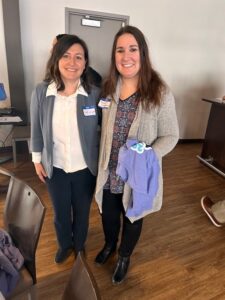 Wright and her sister, Sarah, are the honorary guest survivors for the 2026 American Cancer Society Sole Burner 5K Walk-Run, set for May 9 in Appleton. ThedaCare is the presenting sponsor for the event.
For 42 years, thousands of Sole Burner participants and volunteers have helped raise more than $7.2 million to save lives from cancer. Money raised from the annual event helps fund local programs and services as well as critical cancer research.
‘What I Was Born to Do’
Cancer touches countless families. Wright’s family knows this all too well. Her sister, Sarah, survived breast cancer. Wright’s brother, Paul, survived testicular cancer. Their father has chronic leukemia.
Still, Wright’s personal experience with cancer wasn’t what drew her to oncology. Her first love was pediatrics.
“My mom suggested nursing, to which I admit, I rolled my eyes,” Wright recalled. “The night before I registered for college classes, I had a dream I was a nurse and helped someone simply by holding their hand. So, the next day, I declared a major in nursing.”
Wright graduated with her nursing degree from the University of Wisconsin-Oshkosh. A chance opportunity set her on the path to working in cancer care. She was set to complete her required internship at a children’s hospital but the opportunity fell through.
“My professor had to find me an alternative,” Wright said. “She told me there was an opportunity in oncology. I took it and found what I was born to do.”
Wright became a cancer navigator in 2016. In her role with ThedaCare Cancer Care, she works with patients shortly after they receive a cancer diagnosis, providing resources and support as patients need or wish.
People’s feelings upon getting diagnosed often run the gamut and may include a turbulent mix emotions, Wright said. She strives to assist people wherever they are in their cancer journey.
“I definitely encourage them to advocate for themselves,” she said. “If you can be as knowledgeable about your diagnosis as possible, it allows you to be a good consumer of your health care.”
Wright said her career has helped shape her outlook on life.
“Through this work, I was fortunate to learn at an early age to appreciate every day because life can change in an instant,” she said.
It’s a perspective that would serve her well for what was to come.
‘Never Thought it Would be Me’
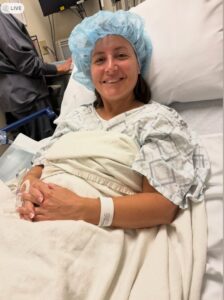 Wright’s first breast cancer diagnosis came in 2021. At just 42 years old, she learned she had ductal carcinoma in situ (DCIS) breast cancer in her left breast. With DCIS, the cancer cells are confined inside a milk duct in the breast.
“I knew the statistics. One in eight women will be diagnosed with breast cancer in their lifetime,” Wright said. “Like most though, I never thought it would be me.”
Wright chose to undergo a left mastectomy with reconstruction. Because DCIS does not spread, she didn’t need additional treatment.
Following her surgery, Wright continued with mammograms and monitoring. Whenever she would receive her mammogram results for her right breast, the report would also note her dense breast tissue. This is a common finding, affecting about 50% of women in their 40s, Wright said. She didn’t think much of it at the time.
When someone has a first-degree relative with cancer, siblings become eligible to start cancer screening 10 years before that relative’s age of diagnosis, Wright said. That meant her sister, Sarah, began having mammograms at 32. In January 2025, Sarah texted Wright saying her mammogram showed calcifications and wondered what that meant.
“Big sister knew it would likely require further work-up, which it did,” Wright said. “Sarah was eventually told she had DCIS breast cancer.”
Because Wright had been diagnosed with DCIS before age 50, her breast surgeon recommended she start having breast MRIs as an additional screening.
“Thankfully I did that,” Wright said. “The MRI revealed a small mass that was invisible on mammogram just three months before.”
Both sisters underwent successful breast surgery in spring 2025.
At the same time Wright and her family were going through their own health challenges, Wright saw the opportunity to effect positive change for other women. She had been learning more about Gail’s Law, both through her work and her personal experience.
Gail Zeamer was a wife, mother and Neenah resident who was diagnosed with Stage 3 breast cancer in 2016 despite having regular mammograms. She didn’t know she was at increased risk for breast cancer and missed diagnosis due to her dense breast tissue.
Zeamer advocated for and helped pass the 2017 Wisconsin Act 201. This requires facilities that perform mammograms to notify patients about dense breast tissue and the increased difficulty it brings to detecting breast cancer.
The fight didn’t stop there. Zeamer continued to advocate for supplemental screenings – such as MRI and ultrasound – for people with dense breasts or who are at an increased risk of breast cancer. Tragically, she died in June 2024 at the age of 56.
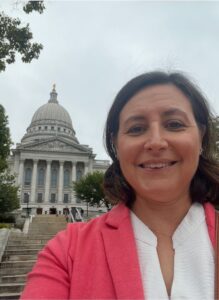 Wright and others continued Zeamer’s work. In October, Wright traveled to Madison to testify before lawmakers. In March 2026, Gov. Tony Evers signed the bipartisan Gail’s Law.
Honorary Survivors
Wright said she’s honored to stand alongside her sister as the honorary survivors of this year’s Sole Burner.
Throughout her career, Wright said she has witnessed firsthand the power of people’s generosity. Funds raised from the Sole Burner go toward supporting critical needs like transportation and hotel stays for people undergoing treatment, as well as research.
Wright said she’s confident the community will again rise to the occasion and give generously during the Sole Burner.
“I’d like to thank this community and my colleagues at ThedaCare for embracing me and my family,” Wright said. “I know that good will come out of this adverse situation and we will all be better for it.”
Visit the 2026 American Cancer Society Sole Burner 5K Walk-Run to sign up, donate or volunteer for the annual event.