
Abe Weber takes Appleton International Airport to new heights
Appleton International Airport director Abe Weber doesn’t let anything get in the way of a good idea.
Weber spent 10 years trying to secure a direct-to-Dallas flight, knowing there was strong connectivity between the region and Texas. He also knew there were local companies with plants in Mexico, which is an easy connection from Dallas. When it finally happened in December 2023, he wanted to share it with the community in an iconic way: by driving a team of longhorns down College Avenue to the airport.
“And, you know, we found out that longhorn cattle are not native to Appleton,” Weber says. So he pivoted to the next-best idea: a bunch of riders on horseback.
“We weren’t able to secure a permit to shut the whole College Avenue down, so we did have to make some adjustments,” says Weber, who arranged for riders to be filmed on sidewalks at various recognizable locations: Lawrence University, Houdini Plaza, the Hilton Appleton Paper Valley, the Fox Cities Performing Arts Center.
The result is a memorable promotional video that celebrates the fact that the airport now has an American Airlines flight direct to Dallas.
The nonstop route — and its creative promotion — exemplifies ATW’s success under Weber’s leadership. His relentless pursuit of partnerships has driven the airport to a nearly $2 billion annual regional economic impact and to serving a million travelers in a single calendar year in 2024, hitting the number again in 2025 by October. Weber’s 50-person team shares his passion and ingenuity, whether leading horses down College Avenue or dressing as Saturday Night Live characters for a Halloween social media post.
This innovative approach has secured major improvements during Weber’s tenure, including a $66 million concourse expansion from six to 10 gates (completed in time for the 2025 NFL draft) and the addition in 2022 of Wisconsin’s only Allegiant base, which Weber credits as key to the airport’s rapid three-year growth.
“The airport is the most important piece of economic real estate in Northeast Wisconsin, and one of the most important across the state,” says Outagamie County Executive Tom Nelson. “And there’s no exaggeration. Abe Weber and his entire team are totally dedicated to that airport, and the results speak for themselves.”
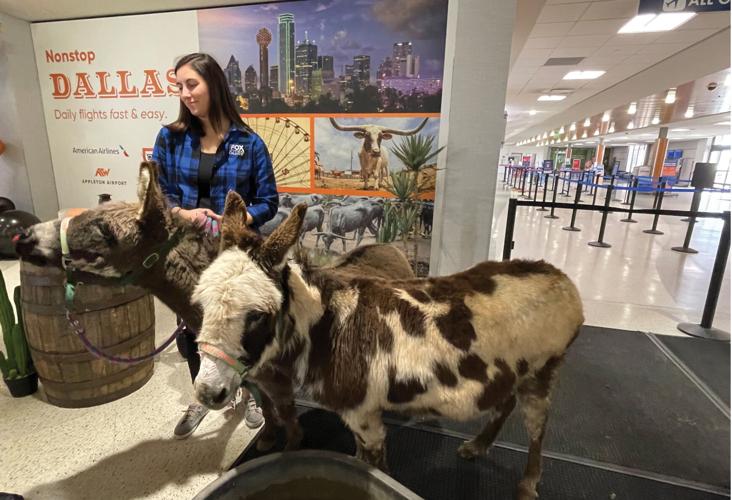
When ATW announced its direct-to-Dallas flight through American Airlines in 2023, its Texas-sized promotion included visits from ranch friends, including these mini-donkeys, shown with former Fox Cities Convention & Visitors Bureau marketing & communications manager Maddie Jack. Photograph courtesy of Appleton International Airport
Eliminating travel friction
Weber’s focus on customer experience is a key factor that has led the community to repeatedly choose the airport, so solidly that ATW now has five airlines with 23 nonstop destinations.
“Our growth has been really a lot of planning and preparation and getting to understand what the community needs are for this airport,” Weber says. “The growth has occurred because of the community support. …We wouldn’t be able to upgrade aircraft size, and then certainly we wouldn’t be able to add new routes if it wasn’t for the community choosing to fly out of Appleton airport.”
Weber came to ATW in 2005 as an intern and moved through several roles, including operations and maintenance manager, before becoming airport director in 2013. Weber began hosting regular meetings with a business travel advisory group, knowing that the convenience of local travel impacted employee satisfaction and retention. In 2016, ATW followed up with a substantial study to quantify that value.
“We understood this concept of travel friction,” Weber says. “How often as a business traveler do you have to start your business trip with a two-hour drive or a three-hour drive to an airport down the road?”
More importantly, why were they willing to? The answer: cheaper airfare and the prospect of a nonstop flight.
Weber set out to make it faster, easier and more convenient for travelers to reach their destination through ATW.
About the same time, Weber also led an internal initiative to send key staff members through Lean manufacturing training at Fox Valley Technical College. Weber had gone through the training in 2012 when he was still in the operations role, applying it to airfield inspection reporting and general improvements; that experience helped him to see how it could potentially translate into customer experience and make the airport a better place for the community.
“We looked at the customer journey as a manufacturing process, almost,” Weber says. Just like a manufactured item goes through multiple steps before becoming a finished product, a traveler must go through multiple points before getting on their plane.
One of the strengths of the ATW team, Weber says, is that “we have a group of dedicated, passionate individuals that are focused on elevating that customer experience.”
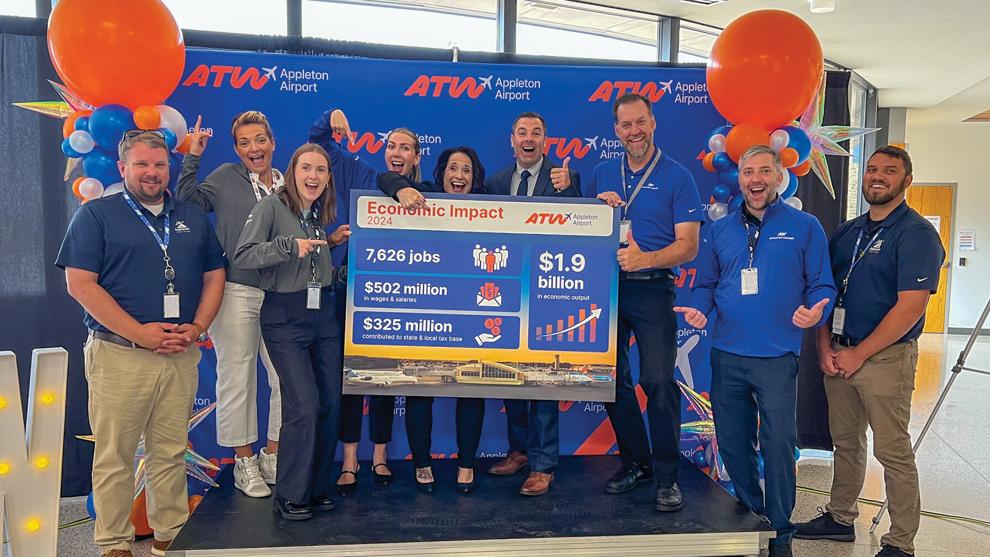
Tourism Economics announced that ATW’s regional economic impact has reached nearly $2 billion, showing significant growth during the past decade. Photograph courtesy of Appleton International Airport
Community impact
The airport’s economic impact stretches far beyond its growing passenger lists, and diversifying services has been part of its plan. The 1,700-acre ATW campus includes businesses such as Gulfstream, the FedEx air cargo distribution center, Air Wisconsin, Fox Valley Technical College’s Public Safety Training Center and the aircraft rescue and firefighting (ARFF) training facility, as well as the airport’s FBO (fixed base operator), called Appleton Flight Center, which hosts corporate aviation and a flight school.
Fox Valley Technical College President Chris Matheny says the vision for the public safety center was to be able to provide a training center for local law enforcement, but also to draw people from across the country.
“The practical implications were that manufacturing facilities for companies like Pierce and Oshkosh [Corp.] were just a couple of miles away,” he says.
The latest economic development report by Tourism Economics showed that the airport’s annual economic impact has grown to nearly $2 billion in 2025, up from $676 million a decade ago.
“To put things into context, when the Milwaukee Brewers went to the state legislature and the governor, hat-in-hand, asking for money to fix up and to build out their facilities, they bragged about a $2 billion economic impact over 20 years,” Nelson says. “We do that every single year.”
But the economic impact survey doesn’t include what Nelson believes to be the most important component: the positive impression the airport leaves on visiting business owners and investors.
“And that impression translates into, ‘I want to start a business here. I want to expand my national operations to Outagamie County,’” Nelson says. “That simply can’t be quantified, and that’s a big reason why these partnerships are important.”
Outagamie County, which owns and operates the airport, has included up to $44 million for capital improvements in its proposed 2026 county budget for the next phase of the terminal build out and to support needed services and infrastructure, Nelson says.
This fall, ATW opened another 100 acres of property in the business park, capturing an Economic Development Administration (EDA) grant to extend Endeavour Drive to Highway 76, allowing the park to support large-scale hangars. “And that, I feel, is like one of the next really big frontiers of growth and development for Appleton Airport,” Weber says.
Weber says without the partnership and support of Nelson and the county board, the airport wouldn’t have been able to pursue its biggest initiatives. “I don’t think we, or myself, get to the point where you can take some risks without that support,” Weber says. “And so that’s really been a big deal.”
The airport’s achievements in a mid-sized market are impressive, Matheny says.
“Abe is energetic in ways that I don’t see that all leaders are,” he says. “I know it’s not typical to have a world-class facility of that size and scope in a community of our size. And I think Abe sees us collectively as a community where we should have the very best. And there’s no reason that that can’t happen in Appleton, Wisconsin.”
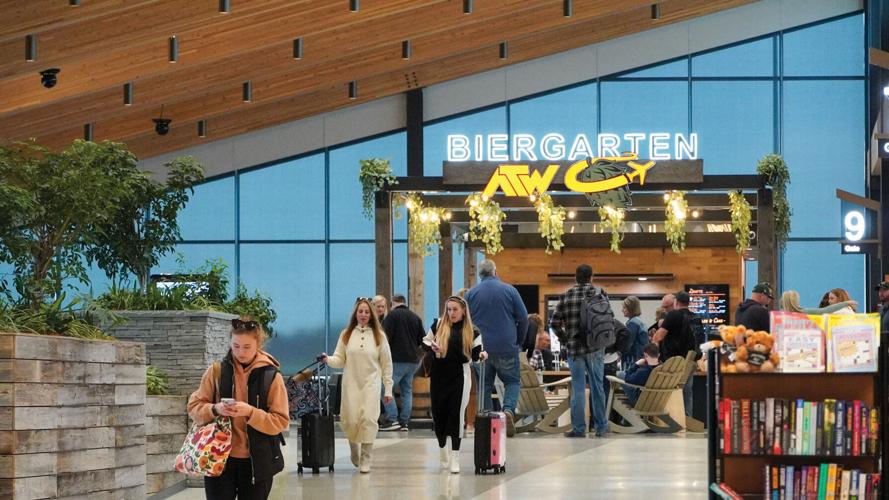
ATW’s concourse expansion includes plenty of new features to reduce stress and bring local touches into the airport, including an atrium-like space featuring a biergarten with a local brew made just for ATW. Photograph courtesy of Appleton International Airport
Pivotal changes
Assistant Airport Director Scott Volberding says two critical changes rapidly boosted momentum for the airport. One was in 2015, when the airport changed its name from Outagamie County Regional Airport to Appleton International Airport. The second was establishing the Allegiant base in 2022.
Weber knew an Allegiant base would be a “massive deal” for ATW, so he began relentlessly pursuing the airline, which at the time didn’t have ATW on its radar.
“I held a weekly call with their airport guy, like, once a week on the dot,” Weber says. “I found out when he had his team meetings. So I’d schedule like an hour right before that.”
Weber had a different pitch ready every week. One call, he’d talk about how the chamber supports local businesses. Another, how FVTC’s flight and maintenance program can support the base. He worked with community leaders on problems like selling the Fort Myers route year-round.
Kristen Schilling-Gonzales, vice president of planning and revenue for Allegiant, says, “I can definitely attest to the fact that Abe is relentless. But that’s great, right? Because he’s such a great advocate for the Fox Cities communities.”
Weber tried some “very creative pitches for why we should be so many different places,” Schilling-Gonzales says, including for the nonstop Punta Gorda, Florida flight.
At the time, Allegiant’s spokesperson said Allegiant didn’t compete with other airlines; they competed with “the couch.” Meaning, the airline was so affordable that it competed with discretionary spending like furniture purchases.
Inspired by this, Weber and his team put together a lighthearted slideshow on couches per capita in the Appleton area, broken down by items like loveseats and davenports.
It may not have been the couch presentation that did it, but Allegiant realized Appleton would be a good partner.
“We previously served some of the larger airports and some other airports in the state, but Appleton outperformed our expectations,” Schilling-Gonzales says. “That’s one of the reasons that we were confident in putting in our aircraft and crew base there for us, and that’s a pretty big step for Allegiant, because we’re asking our team members to potentially uproot their lives to go work out somewhere.”
Allegiant, which has been operating at ATW since March 2009 and has served about 2.7 million passengers through the airport, invested $50 million in establishing a crew base at the airport in 2022 following Weber’s pointed campaign.
The benefit of having the base was that there would be two or three aircraft parked at ATW every night, Weber says. “What we get is three morning launches from Allegiant out to their destinations. You get a better time, right? You get a better schedule.”

ATW leaders held listening sessions with area groups to help plan the features the airport would add for its terminal expansion. Photograph courtesy of Appleton International Airport
Building a career
The last of eight children in his family, Weber, 42, now a married father of four himself, grew up in rural Orion, Illinois on a farm where a neighbor happened to fly corporate jets for John Deere.
“When I was younger, he toured me through the John Deere hangar and through their airplanes. And I really fell in love with aviation from there,” Weber says. “That was my first real spark in my memory of, like, ‘Boy, this is cool.’”
Weber started taking private pilot lessons at age 16 or 17 and earned his license, then went on to earn an associate degree in aviation flight and a bachelor’s degree in aviation management from Southern Illinois University in Carbondale. Weber also later earned a master’s in business from UW-Green Bay.
Flight jobs were scarce at the time, so Weber sent out his resume to various airports and eventually found the internship at ATW. Weber had the chance to work in just about every capacity, including painting runways, mowing and custodial work. “I did all kinds of crazy stuff, fun stuff, but you know, here I am still on my three-month internship,” Weber says.
Weber credits past airport managers as mentors, including Marty Lenss, who appeared on Insight’s cover in 2010 and was a “phenomenal communicator,” Weber says: “He was great at building partnerships.”
Lenss, who is now the director of the Eastern Iowa Airport in Cedar Rapids, says he and Weber “collaborated together really well and always, always worked things out as a team. But honestly, I felt like we were learning from each other.”
Volberding started at ATW at a time when the airport was really undergoing a lot of change, he says. They work well as a team where Weber is the visionary and Volberding has handled the behind-the-scenes project coordination, he adds. That relationship has worked well for the past 12 years.
“That doesn’t happen that often in any industry, that you can get two partners together that can last that long, honestly,” Volberding says. “We understand the mission, we understand our focus, we understand our brand, and as a team, we work together well to try to achieve that vision every single day.”
Expanding with passenger growth
 Since 2015 — when ATW had its name change — it has averaged about 14% growth annually. In 2020, the FAA approved a 60,000-square-foot terminal expansion with up to 10 gates and an additional two if needed.
For that expansion process, ATW leaders held dozens of listening sessions to ensure the airport worked for the community.
This input resulted in ATW deciding to forgo elevators and escalators in favor of sloped walkways, which are more convenient for travelers with mobility issues and parents of young children. That shift saved money on equipment and associated maintenance, electrical usage and insurance costs, Weber says.
The concourse includes new features like a pet relief area, a wall of live plants for stress reduction, an autism sensory room, a mother’s room for breastfeeding and a quiet room. The airport finished its connector section of the project at the end of 2025. It includes an atrium-like, indoor porch space.
ATW’s next big project will be streamlining the ticketing and outbound baggage space, with bids going out in February.
“It’s all about fast, convenient, and it’s modeled after supporting our business community and the business traveler,” Weber says. “But we recognize that if it’s going to work and it’s going to really provide value for the business traveler, it’s going to work for the leisure traveler as well.”
Sweet connections
Gaining business traveler insight is an important part of ATW’s air service development plan, Airport Director Abe Weber says.
“Our goal as an airport is to know our business community better than any other airport out there in the U.S.,” Weber says.
“We ask [businesses] about their travel trends, what are their top city pairs that they’re traveling between today, and if there’s new acquisitions or new business projects that they’re taking on.”
To increase engagement with business travelers, ATW staff utilizes a secret weapon — a bus filled with ice cream in the middle of summer. This summer the ice cream bus visited 70 different locations and local businesses.
“We learn so much about our airport from these visits,” Weber says. “We get to talk to our business travelers, find out where they’re flying, what they like about the airport. And more importantly, what they don’t like about the airport.”
Article first appeared in Insight on Business